
Falcon Physiologic Doppler System for ABI
Falcon Physiologic Doppler System for ABI
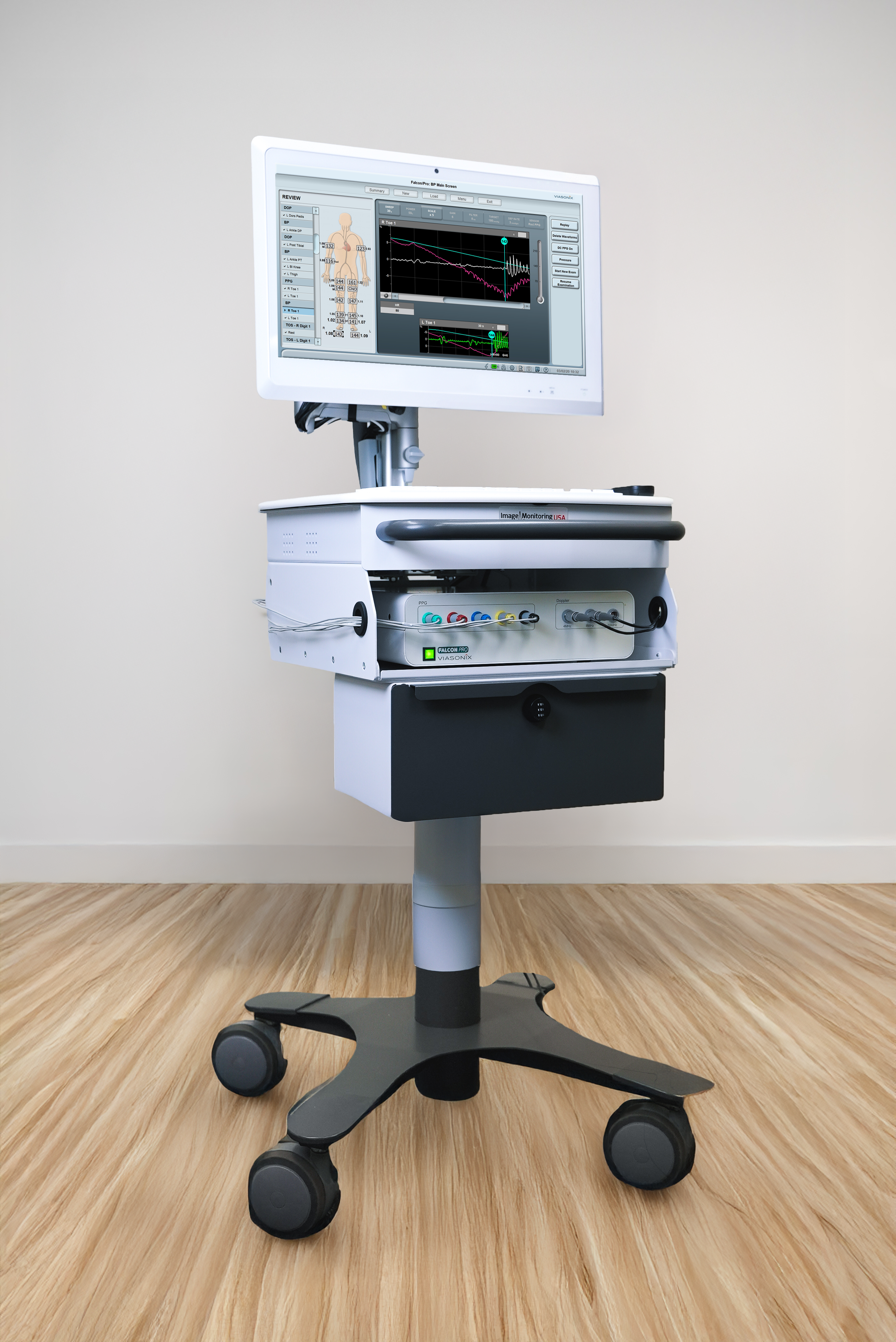
The clinically and widely accepted technique for assessing arterial disease of the legs is by using a CW Doppler standard in The Falcon physiologic vascular system. At Image Monitoring USA, we proudly supply cutting-edge physiologic vascular systems to the American vascular market.
Quality is always our top priority and we incorporate it in all aspects, from the initial product design through all R&D phases, manufacturing, final testing, packaging, and distribution. Therefore, today we are the first choice of our customers for clinical physiologic vascular equipment.
Our Products

Falcon PRO and Falcon Quad PV Testing Systems

Dolphin IQ and Dolphin 4D TCD Testing Systems
Additional Information
What is an ABI Doppler?
The Gold standard for assessing peripheral artery disease (PAD) is to have an ankle-brachial index exam, or ABI test, which is fast and noninvasive. The ABI measures the ratio of the highest systolic pressure at the arm to the lowest systolic pressure at the ankle using an ultrasonic doppler. The Falcon Physiologic device offers bidirectional Doppler probes with a frequency of 4, 8 and 10MHz.
Bidirectionality is necessary for the ankle waveforms to be accurately displayed, and helps to distinguish the capacity of arterial flow toward and away from the probe.
Unlike ultrasound imaging modalities which provide anatomical information, ABI assessment provides a direct indication of the physiological severity of the vascular pathology, such as Peripheral Arterial Disease. ABI testing machines are often used for fast and simple screening of the lower limbs, prior to determining if ultrasound imaging is required.
How to Use?
Measuring the Systolic blood pressure with an ABI machine is simple and requires blood pressure cuffs and a sensor.
Once a blood pressure cuff is wrapped around the measured site, a distal Doppler waveform is obtained. The cuff is then inflated until the distal signal disappears as a result of the total occlusion. The blood pressure cuff is then deflated in a controlled manner, and the pressure at which the distal signal re-appears is determined as the systolic pressure.
An extension to the basic ABI test is the complete non-invasive physiologic studies of lower extremity arteries. It includes placing cuffs not only on the Ankles but also on other segments of the legs. This type of test is detailed in the Segmental Blood Pressures section.
Another important extension is performing ABI before and after an induced stress activity such as walking, treadmill, and tiptoes. This type of test is detailed in the Exercise Stress Test section.
Applications
- Ankle-brachial index (ABI) is a simple test that allows your doctor to determine how well your blood is moving through your legs.
- This test is used by doctors to look for peripheral artery disease (PAD), which is defined by blockages in the arteries that supply the arms and legs.
- A value of 0.9 or lower means you have peripheral artery disease (PAD). And the lower the number, the more artery blockage you have.
- A reading between 0.91-0.99 is acceptable, but it indicates that your peripheral artery disease (PAD) is on the edge.
- A reading between 1.0-1.4 means that you don’t have peripheral artery disease (PAD).
- A reading above 1.4 could represent calcification of the arterial vessels.
Portable ABI Machine
Testing for PAD and other vascular diseases is simple and painless with the help of our portable ABI system, which benefits both the technician and the patient. Image Monitoring USA offers its portable ABI machine with the following amazing features:
- State of the art laptop is provided with software installed.
- It is simple to determine where each cuff should go because they are all clearly labeled and color-coded.
- You can enable the quick ABI exam that inflates all four cuffs at the same time!
- The error message will appear immediately on the screen if any faults are made while taking the test.
- Portable fold up cart is available as an option.